Unlock your most valuable resource — a room of your peers.
peer2peer.group is where peer groups get built and run. The group brings the topics, the group votes, and the hour goes to what actually matters to the people in the room.
Every session goes to what the room actually needs.
Get answers from your peers. Be the answer for theirs.
The room gets smarter every time it meets.
The Problem With Going It Alone
The answer you need is already inside someone else's head.

Most business owners take a lonely path. They try to solve every big problem completely by themselves. The truth is, you are stuck on a challenge that another owner solved last year. At the same time, the lessons you have learned could save a peer months of mistakes. But without a shared space, you will never meet.
Big conferences speak to a generic crowd. Business books are written for everyone, not just you. They offer good advice, but they miss your specific problems. Whether you want to join a peer group or step up to lead one yourself, the facts are the same. The help you need is out there right now, trapped with another leader who is also tired of working alone.
What It Is
The simple way to run peer meetings.
Peer2Peer.group is a tool that works side-by-side with Zoom or any video app you like. It makes it simple to connect with your group, stay on track, and share advice with other business owners.
The agenda comes from the room
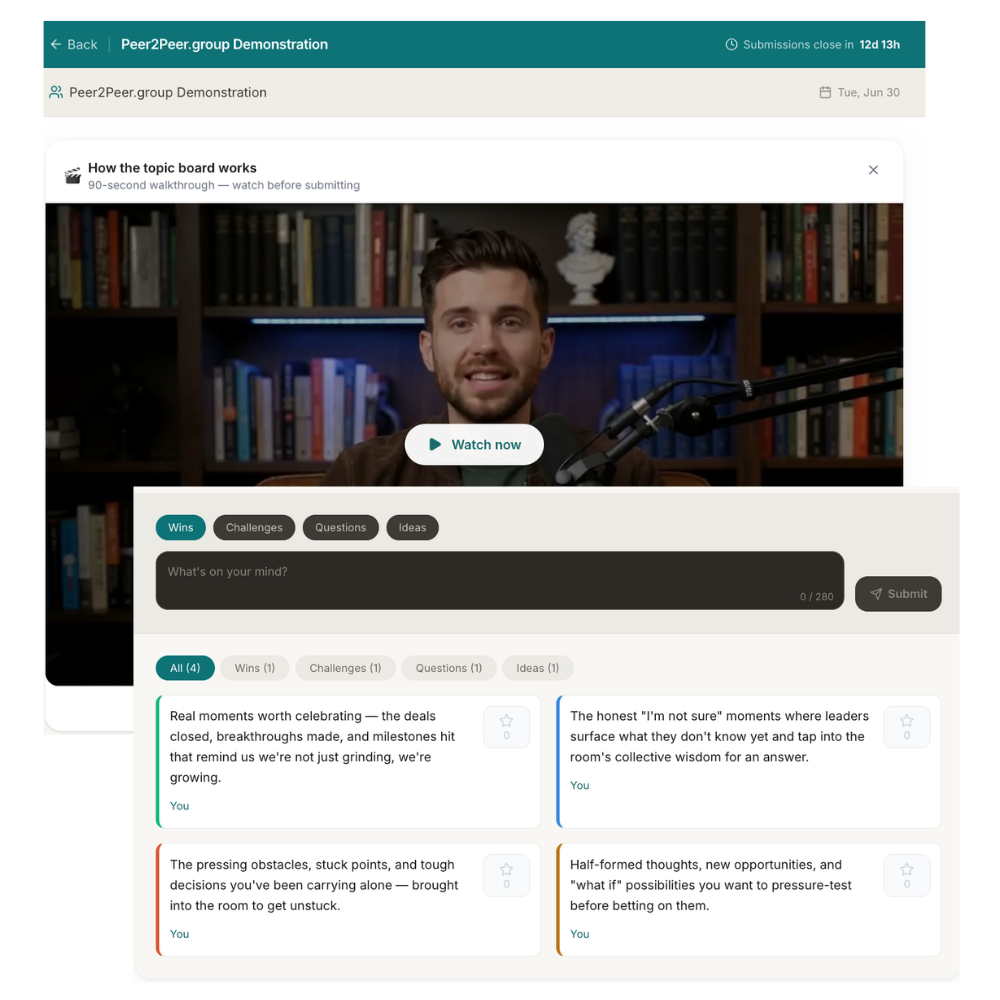
Before every session, everyone posts what they're carrying — wins, challenges, questions, ideas. Everyone votes. The top of the list is the meeting. Nobody guesses what the room needs, because the room already said.
The answers come from the seats
Somebody in that hour has been through the thing being discussed. You get the specifics — the tool, the wording, the number, the mistake to skip — not the principles.
Nothing evaporates
The discussion, the topics, and every resource the group shared land in every inbox afterward. What used to disappear when the call ended now accumulates.
Choose Your Path
Which side of the room are you on?
I Want to Lead a Group
You've got people you could gather, and you've never gotten around to it.
We handle everything except the part you're good at. Leading.
I want to lead a group →I Want to Join a Group
You're trying to get better and you can't find the answers you need.
Find the room where your question is the agenda.
I want to join a group →The Mechanics
What actually happens in a session.
Every session gets its own Topic Board the moment it's scheduled. In the weeks before, the people in the group post what they're grappling with — a win worth unpacking, a challenge, a question, an idea they're circling. When the group comes together, the Host opens the voting room and everyone votes. The topics that resonate most rise to the top, and that becomes the agenda.
From there the Host calls on whoever raised each topic, asks for the backstory, and opens it up. Usually someone in the room has faced the same thing and can say what worked. Near the end, the group shares the resources that are actually moving the needle for them right now — the websites, podcasts and tools nobody would have gone looking for. Afterward, all of it goes out to everyone who attended.
Nobody has to build an agenda. Nobody has to guess what the room needs. And the thing you walked in carrying doesn't have to survive somebody else's plan for the hour.

Tim Yates, Founder
Why I Built This
I needed this room before I ever built it.
I know what it's like to be the only person in your position for a hundred miles — carrying questions that nobody nearby can answer. And I know what it's like to want to gather people and never start, because the work of setting it up is a job on top of your job.
Where I Found the Answer
I found it in a room in Minneapolis. Seventy people, and the facilitator hadn't prepared a single topic. Everyone submitted what they were wrestling with, everyone voted, and we spent a day and a half on whatever rose to the top. I got more out of it than any conference I ever traveled to and paid thousands to attend.
I watched that format work four times — same result every time.
So I built peer2peer.group. And I'm hosting my own group on it.
— Tim Yates, Founder
How It Works
Three steps.
The value is in the room, not the setup.
01
Start a group, or join one.
Lead the people who do what you do — or take a seat in a room that already exists.
02
Show up and speak up.
The agenda is already set by the people in it. Bring what you're carrying, and answer what someone else brought.
03
Leave with what you need to get better.
Answers to what you're actually facing, resources you'd never have found, and the whole hour in your inbox afterward.
Pricing
Free to join. Simple to host.
Members
Free to join
Joining a group is between you and the Host. Some groups are free. Some are paid — the Host sets the price.
Hosts
$19.95 / month
Run free groups at no cost. Charge for your group and you keep 88% — the 12% platform fee on paid rooms is in effect, including during the beta.